
Do you even Louvre me?
What it means to belong (or not) in the world’s most famous museum

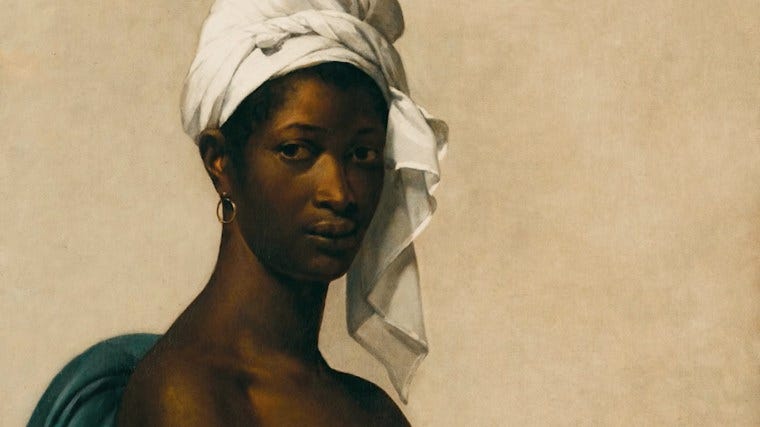
“She was painted like a normal person.”
To get to any one thing at the Louvre, you must encounter many others. This is the greatest pleasure of the experience for me — that the aim becomes aimless. I have an annual pass, which facilitates this goal: no lines, and no pressure to try to take in a set or certain amount of the museum’s colossal collection.
So it was unintentionally that I ended up sitting for a while in front of Madeleine, in quiet conversation with the woman in the painting. And it was unintentionally, too, that I ended up in the middle of a tour group. It was less unintentionally that the guide, looking at in front of her and me in her peripheral, said, “Elle a été peinte comme une personne normale.”
This isn’t happening, I thought. Is it really happening?
On my notepad, I jotted a line about the situation:. “As I sit in front of one of the most important paintings of a woman of colour, a tour guide with only white patrons talks about her being painted as a normal person.”
I dared not look at any of the people around me. Gallery etiquette holds that we — a paid tour group and a random museum-goer — orbit around one another, neither bequeathing space nor interacting.
But I swear, the guide’s eyes glitched over mine, her look holding a soupçon of…what? Acknowledgement? Apology?
Oh no. No, no. She’s going to say something about her skin colour.
While writing, I didn’t hear everything the guide said, but I did register a few snippets. Paraphrasing, they were to the tune of: dark skin was hard to paint; Black people are rarely subjects of this era of art; this painting was likely done to show off the artist’s skill.
And then:
“Benoist a créé une peau crédible.”
Benoist created a credible skin.
I kept staring at my notebook, then my pen…and then the hand that held it. My hand. My dark-skinned hand.
Portrait de Madeleine. Portrait d’une femme noire. Portrait d’une negresse. Marie-Guilhelmine Benoist’s oil painting has shouldered many titles, each one trying to better represent the figure in the frame and the vernacular of the times. Thought to be a woman between 20-40 years old, her name was not known until 2019 when historian Anne Lafontnew identified her as a woman from Guadalupe: “Madeleine,” a member of Benoist’s brother-in-law’s staff.
Oddly, a France TV clip from this year calls her “La Joconde noire oubliée” — essentially, the Black, forgotten Mona Lisa — a strange moniker considering Madeleine’s portrait is arguably the most famous Western painting of a woman of colour, and has been since she was unveiled in 1800. She sits in the prime position on a wall of works by Jacques-Louis David’s disciples (Benoist was one); she is the final image of Beyoncé and Jay-Z’s “Apeshit” music video. I remember, vividly, seeing her 17 years ago, on my first Louvre visit. I loved seeing her again on this one.
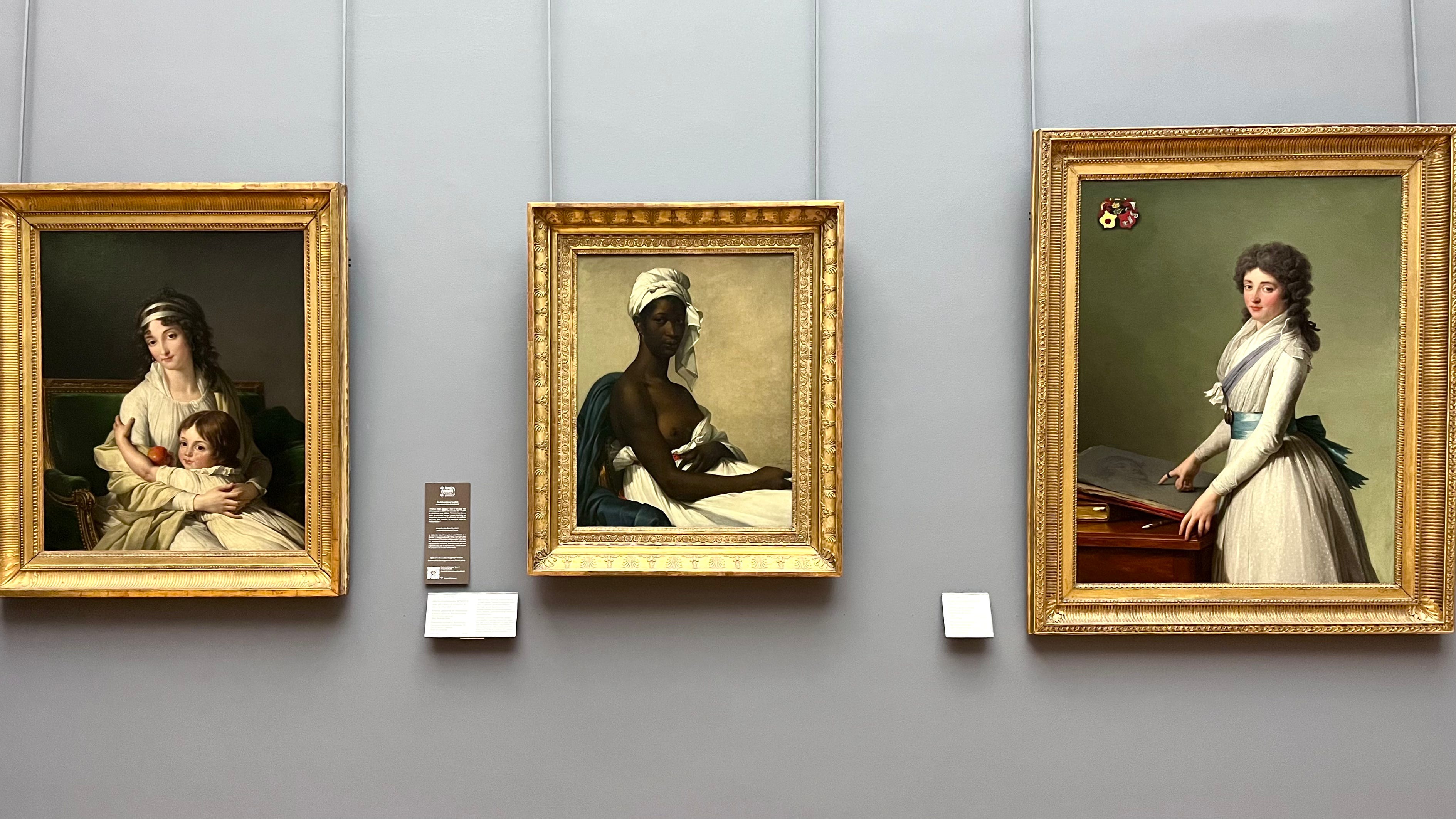
I had been sitting for some time on the middle cushion of the bench that is centred on Madeleine, my notepad open on my lap, when the tour group arrived. Two of the group members, looking for respite, slowly made their way to sit on either side of me. Their guide thus had to angle herself to address her flock, which now had me — a dark woman, aged between 20-40, positioned directly in front of a painting of a dark woman, aged between 20-40 — in its milieu.
It felt like a scene from Arrested Development.
Why is this so weird, why is this so weird, why is this so weird?
I asked myself this then. And I am asking it again now.
Why is this so weird?
I now have some ideas.
The Louvre is, and always has been, a colonial project, first built to protect the monarchy and since then a place to showcase the nation’s masterpieces. And that’s something those of us from “the colonies,” without Euro-centric features and family lines, can clock within moments of entering the building.
The museum’s collection cuts off at 1850, and is built from acquisitions, donations, and much looted art from the Napoleonic conquests, particularly from Italy and Egypt. It was only in the year 2000 that the Louvre started a permanent collection of art from Africa (outside of Egypt), Asia, Oceania, and the Americas with the opening of the Pavillon des Sessions. One hundred and twenty pieces of art, mostly sculptures and objects, represent these four continents – a hiccup within the 35,000 plus total works on display. Even when it tries to be, the Louvre is not inclusive.
I think this matters. I think it matters because the Louvre is the most famous, most visited museum, of any kind, in the world. “Hang it in the Louvre!” is an idiomatic turn of phrase, used to praise an excellent work of art. What started as a nationalistic project for France has grown to be a symbol of prestige globally. But actually, it is nearly impossible to hang anything in the Louvre.
As evidenced by my membership with Amis du Louvre, I really like the place — but I don’t know how much it likes, or thinks about, me. It was built to protect and promote a version of France that no longer exists. This new France, which includes me, is ever-changing; its cultural institutions are not.
I also don’t know that the Louvre can, or should, change. And I cannot fault the tour guide for all that she said. White painters did find it hard to render darker skin tones. Not many of them had Black or brown subjects as sitters. I take issue with her use of the otherizing word “normal” and at the same time, I recognize that it is still, in 2025, quite fiddly to talk about race. This is not an experience unique to the Louvre, but it is, by design and on purpose, part of being at the Louvre.
“They have moved on but that was awkward,” I wrote in my notes. And it was awkward because, by virtue of where it lives, Madeleine’s portrait is, and always will remain, an exception.
Benoist’s portrait of Madeleine has more text around it than the neighbouring pieces, including an additional brown plaque that is part of the museum’s effort to give certain artworks a “voice.” I read every line on and “from” Madeleine.
“Regardless of my name, I try to embody the noble beauty of all black [sic] women,” the latest blurb starts. It ends with: “Maybe one day I will have a surname.”
I remember thinking, Huh?
Madeleine had a surname. Maybe she had a middle name, too. And she knew all her names. She was known to herself, and to the people she loved — it’s the rest of the world that was in the dark. This narrative, this ask, doesn’t come from her. Thus, as she was in front of Benoist, Madeleine continues to be defined by the white gaze — even when they’re trying to do better.
So how am I to reconcile the weirdness with my love of the Louvre? It seems my only choice is to be intentional on my visits, as I was when interacting with Madeleine, and the tour guide: aware, impressed, uneasy — and always in my own, credible skin.
Bibliography:
Jimena Escoto, “Masterpiece Story: Portrait of Madeleine by Marie-Guillemine Benoist,” in Daily Art Magazine, March 16, 2025, accessed October 21, 2025.
Duane McKinley, “BHM: Why is the Louvre Hiding African Art?” in Afropunk, February 1, 2019, accessed October 21, 2025.
Holly Selby, “African Art Sits Uncomfortably at the Louvre,” Baltimore Sun, October 5, 2000, accessed October 21, 2025.
James Smalls, “Slavery is a Woman: “Race,” Gender, and Visuality in Marie Benoist’s Portrait d’une négresse (1800),” Nineteenth-Century Art Worldwide, 2004, accessed October 21, 2025.
Dr. Susan Waller, “Marie-Guillemine Benoist, Portrait of Madeleine,” in Smarthistory, September 26, 2018, accessed October 21, 2025.
Poetic and symbolic that this is happening in a moment you are yourself a part of the museum. A fixed presence in that moment.