
july 2025 in books
Bite-sized book reviews for everything I read in the last month.

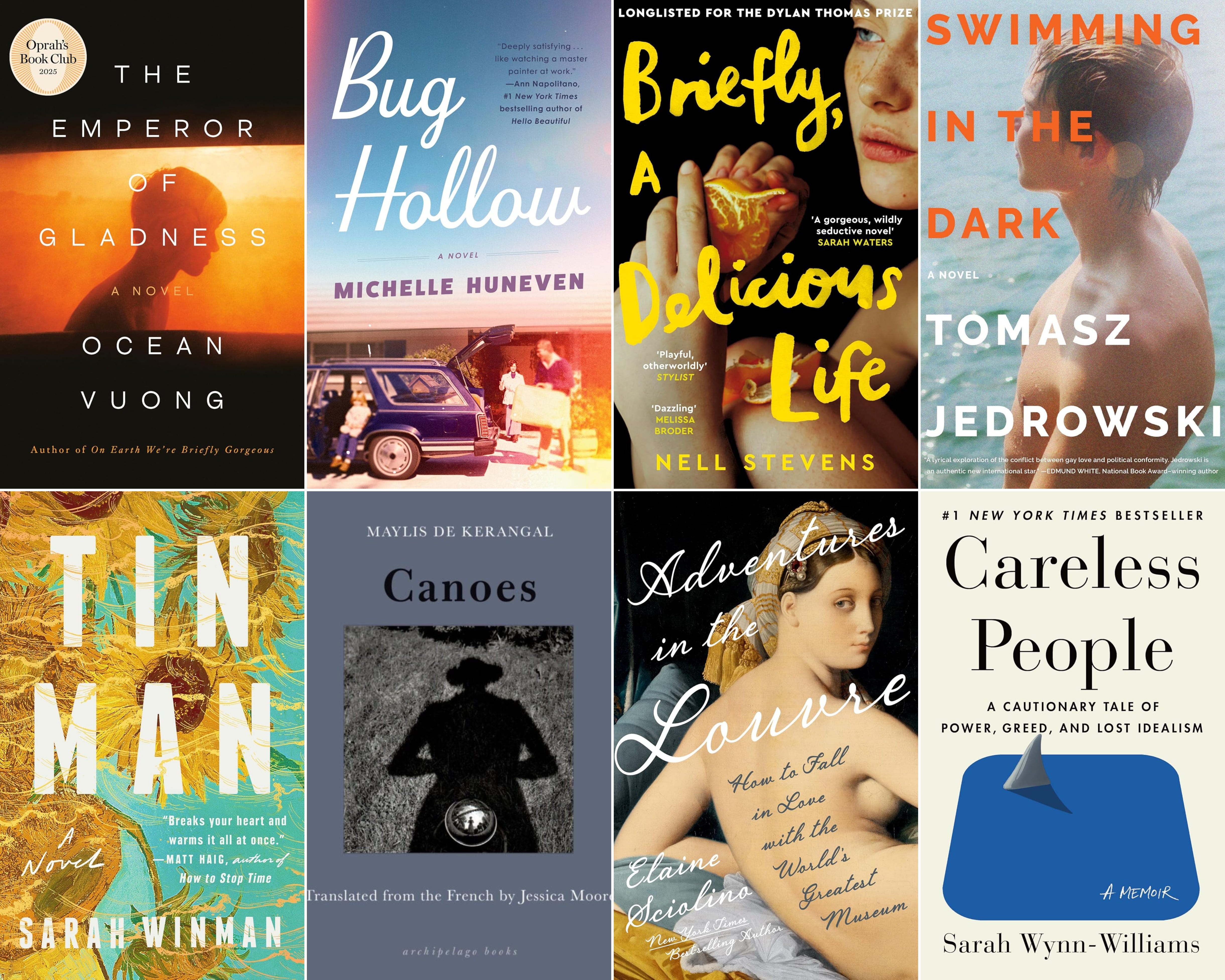
A wee delay getting this out. Blame it on the July sun and the slowness of August.
Top recommendations: Tin Man, Adventures in the Louvre, and Careless People.
The Emperor of Gladness, Ocean Vuong
The misadventures of a group of intergenerational misfits as they scuffle to make life work in their little town of East Gladness, Connecticut. This is a heartbreaking yet surprisingly funny love letter to the working class and hidden labour that keeps American cities moving. The characters are so real, and lovable, as they fight towards and through what reads like a second, or adult, coming of age. Vuong delights, as expected, with lush prose; a character even says, “Words cast spells… That’s why it’s called spelling.” Vuong, by that definition, is a magician.
Bug Hollow, Michelle Huneven
Bug Hollow started with small scenes so tender I had to pause between paragraphs to breathe, then rushed to the finish line with all cylinders firing — and that didn’t work for me. The novel spans generations and has a lot of characters from the get, but the turn in the final chapters to include surprise lesbians and immigrants and the threat of ICE felt crammed in.
Briefly, A Delicious Life, Nell Stevens
Funny, observant historical fiction narrated by a horny, bisexual ghost named Blanca, forever stuck in the lustiness of being a 14-year-old girl. Through Blanca, we learn about a writer named George — born Amantine-Lucile-Aurore Dudevan — and her lover, the composer Frédéric Chopin, when they arrive in Mallorca as Chopin’s health is failing. Blanca as unreliable as she is charming, and the light eroticism is playful and biting, making this a fantastic summer read.
Swimming in the Dark, Tomasz Jedrowski
A gorgeous opening with a strong, interesting narrative style, that lost me in the end as it became predictable. A shame, because I loved the way Jedrowski introduced his characters and story.
Tin Man, Sarah Winman
This is a slow burn, with jumping timelines, but absolutely worth sticking with, as Part Two will hit you right in the gut. The book is very much about death and dying, but also about how much we are able to hold for the ones we love — how much we can know without revealing a thing. I am purposely mum on the synopsis; it’s worth discovering the rich tale and all its turns for yourself.
Canoes, Maylis de Kerangal
A set of interconnected stories on belonging, loneliness, womanhood. Some sections are delicate and other are explicit; de Kerangal expertly uses metaphor and symbolism with her sort of rambling style to draw you into the speed and weight of each story. There is a focus on voice throughout — a French woman struggling to learn English, another trying to find the right timbre at a voiceover audition, a daughter erasing her mother’s words from an answering machine — including in the creation of the translated text. I loved Jessica Moore’s translator’s note at the end, as it echoed the same sentimentality for individual expression as the author.
Adventures in the Louvre, Elaine Sciolino
I love how much Sciolino loves Paris — and how much this love of Paris is backed by both feeling and research. Because sometimes, it’s not enough to say, “It’s Paris!” in response to questions about this famous city. In Adventures in the Louvre, Sciolino sets her sights and journalistic skills on the most famous museum in the world to tell us how it came to be and why she thinks it still matters — emphasis on the she. Because this is a biased book; it reads like a memoir and includes copious anecdotes and personal stories. Sciolino writes not for art historians, but for laypeople (so, the majority of any museum’s audience). She also wrote under the supervision and approvals process of a French institution, and I appreciate her attempts to include criticisms and concerns. It is a daunting task to try to synthesize this massive collection, this cultural icon, into a single text, and Sciolino does it with such enthusiasm as to make one fall in love, either with the Louvre or with her falling in love with the Louvre. Whatever the case, it worked on me; along with a friend, I am subscribing to the museum’s annual pass starting in September.
Careless People, Sarah Wynn-Williams
A scathing memoir from a former Facebook employee who chronicles the ways the tech giant abuses their employees and their power. Reading this felt dystopian. They — Zuckerberg, Sandberg, and Meta higher-ups — knew just what they were doing when they allowed Trump and his cronies to peddle false narratives on Meta platforms. They knew, and far from stopping it from happening, they liked it. Wynn-Williams particularly highlights the way Zuckerberg reacted, how he saw what the system he built could do. A chilling image in the book is one of Zuckerberg at the table with world leaders; when they step down, he will remain, a type of self-appointed king amongst politicians. And then there is the absolutely atrocious, anti-feminist, anti-mother, opposite of “lean in” treatment directed at Wynn-Williams herself, emblematic of how the heads of the company see their employees: disposable. This is an unnerving but excellent read.